
Prepared for Political Education and Civic Understanding
Note: This paper is prepared for political education websites and citizens seeking to understand philosophy and its relationship to practical governance and democracy. It provides an accessible introduction to philosophical inquiry and shows how philosophical thinking—particularly political philosophy—informs and complements empirical social science in advancing understanding of politics and society.
The paper emphasizes that philosophy is not merely abstract theorizing disconnected from practical concerns. Rather, philosophical inquiry shapes how societies think about justice, rights, governance, and human flourishing. Understanding the branches of philosophy and the relationship between political philosophy and political science enables citizens to engage more thoughtfully in political discourse and to recognize the value commitments underlying political positions.
For educators, the paper provides frameworks suitable for teaching students about philosophical thinking and its significance for democratic society. For policymakers, it clarifies how philosophical principles and empirical evidence together inform policy development. For engaged citizens, it provides tools for more informed participation in democratic deliberation.
Abstract
Philosophy is the systematic inquiry into fundamental questions about reality, knowledge, values, and the basis of human existence. This paper provides an accessible overview of philosophy and its major branches—metaphysics, epistemology, ethics or moral philosophy, logic, and aesthetics—explaining the central questions each addresses and the significance of philosophical inquiry for contemporary society. The paper then explores political philosophy as a distinct branch of philosophy, examining its scope, central questions, and normative orientation. Finally, the paper provides a detailed comparison of political philosophy and political science, demonstrating their complementary but distinct approaches to understanding governance, politics, and the organization of human society. Understanding these distinctions is essential for informed citizenship and for recognizing how theoretical principles shape practical political decisions [1][2][3].
Part I: Philosophy—Definition and Nature
What Is Philosophy?
Philosophy, derived from the Greek words philo (love) and sophia (wisdom), literally means “love of wisdom.” More precisely, philosophy is the systematic, rational inquiry into fundamental questions about reality, knowledge, values, and human existence [4]. Philosophers ask questions that other disciplines often take for granted: What is real? What can we know? How should we live? What is beautiful? How should we reason? What makes a government legitimate?
Philosophy differs from other forms of knowledge in its commitment to critical reasoning and systematic analysis. Where science accepts certain findings as established facts, philosophy questions the foundations of those facts. Where common sense assumes certain truths are obvious, philosophy examines whether those truths can be justified through rational argument [5]. Philosophy is thus fundamentally reflective and critical, seeking not merely to describe reality but to understand and evaluate our understanding itself [5].
The Method of Philosophy
Philosophers employ several distinctive methods:
Conceptual Analysis: Philosophers examine concepts—such as justice, freedom, knowledge, or beauty—to clarify their meaning and logical relationships. This involves asking: What exactly do we mean by this concept? What are its essential features? How does it relate to other concepts? [6]
Logical Argumentation: Philosophy relies on careful reasoning and argument. Philosophers construct arguments, test their validity, and examine their implications. Claims need supporting reasoning, not just assertion [6].
Thought Experiments: Philosophers often use imaginary scenarios to test ideas. These thought experiments help clarify concepts and reveal hidden assumptions. For example, philosophers might ask, “If everyone acted only in their self-interest, would society function?” to explore questions about ethics and social cooperation [6].
Historical Inquiry: Philosophers often examine how influential thinkers throughout history have addressed fundamental questions, learning from their arguments and mistakes [7].
Why Philosophy Matters
Philosophy is practically important to society for several reasons:
Clarifying Values: Societies must decide what values matter most—justice, equality, liberty, security. Philosophy helps clarify these values and how they relate to one another [8].
Examining Assumptions: Every political or ethical position rests on underlying assumptions. Philosophy examines these assumptions, asking whether they are justified and what their implications are [8].
Resolving Conflicts: When people disagree about important matters, philosophy provides methods for rational dialogue. By clarifying concepts and examining arguments, people can sometimes resolve disagreements or at least understand exactly where they differ [8].
Providing a Critical Perspective: Philosophy enables societies to critique their own practices. Rather than accepting inherited practices as inevitable, philosophical inquiry asks whether they can be justified and whether alternative approaches might be better [9].
Guiding Policy: Philosophical thinking about justice, equality, rights, and human dignity informs policy decisions about law, education, healthcare, and governance [9].
Part II: Major Branches of Philosophy
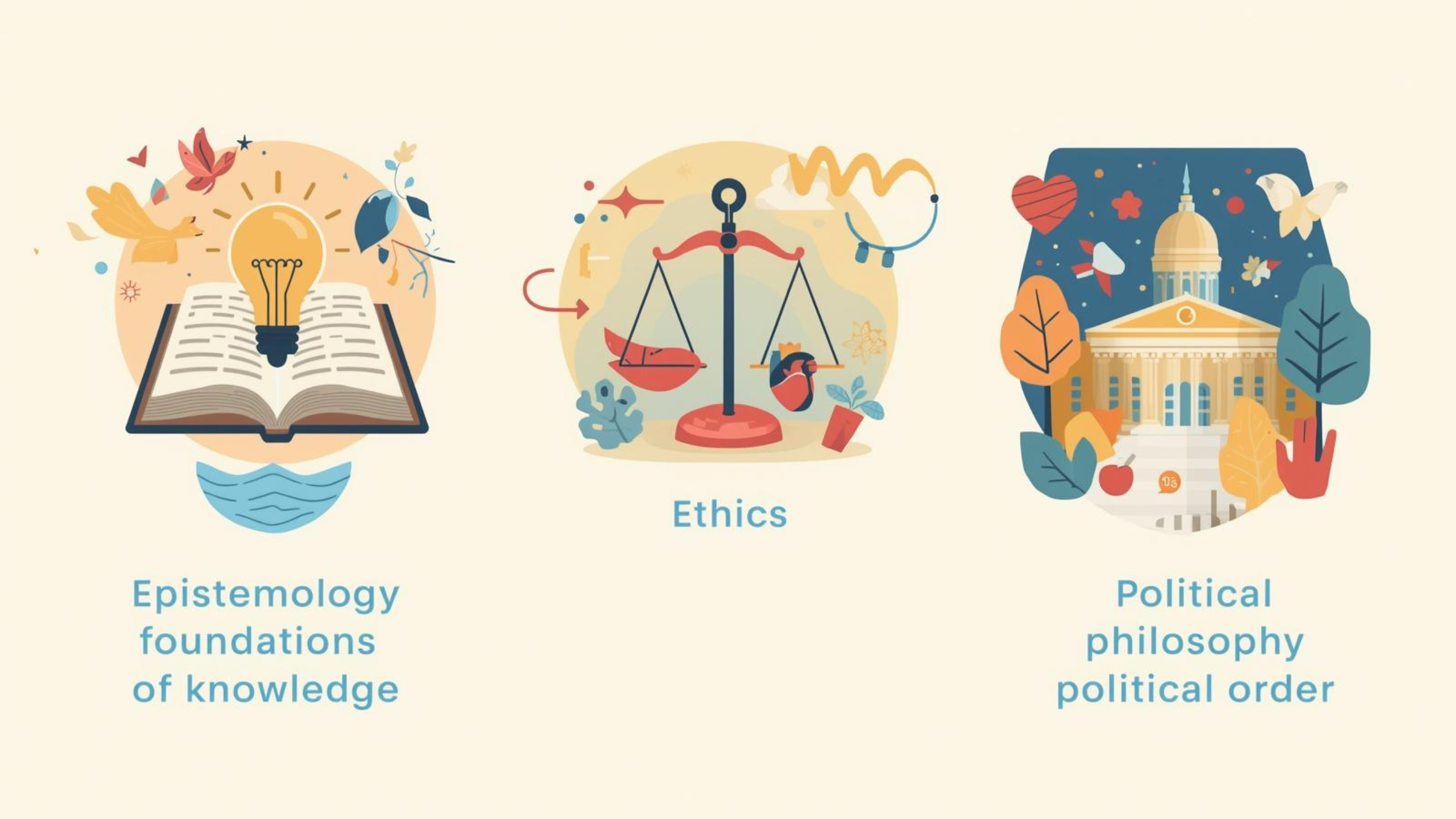
Philosophy addresses such a broad range of questions that it has developed distinct branches, each focused on particular domains of inquiry. While these branches overlap and inform one another, they provide useful frameworks for organizing philosophical inquiry.
Metaphysics: The Study of Reality and Existence
Metaphysics is the branch of philosophy that inquires into the fundamental nature of reality, existence, and the universe [10]. Metaphysical questions ask: What is real? What exists? What is the fundamental nature of being? Do we have free will, or is everything determined? Is there a God? What is the relationship between mind and body? How do objects persist through time? [10]
Core Questions in Metaphysics
Scholars often divide metaphysics into several areas:
Ontology addresses the fundamental question, “What exists?” It examines categories of being—substances, properties, relations—and asks how they relate to one another. For example, do abstract objects like numbers or propositions really exist, or are they mere human constructs? [11]
Cosmology examines the nature of the universe. It addresses questions such as Did the universe have a beginning? Is it infinite? Are there fundamental laws governing all events? [11]
Philosophy of Mind investigates the nature of consciousness and mental phenomena. It asks: What is consciousness? How does the mind relate to the physical brain? Is there such a thing as free will, or are our choices predetermined? [12]
Metaphysical Realism vs. Anti-Realism addresses whether reality exists independently of human minds. Realists argue that an objective reality exists independently of our perception. Anti-realists argue that reality depends somehow on human minds or perspectives [12].
Significance of Metaphysics
Metaphysical questions underlie many practical concerns. Questions about free will relate to moral responsibility and criminal justice. Questions about the nature of consciousness inform medical ethics and debates about artificial intelligence. Metaphysical assumptions about human nature shape political philosophy [13].
Epistemology: The Study of Knowledge
Epistemology is the branch of philosophy concerned with knowledge—its nature, sources, scope, and limits [14]. Epistemological questions ask: What is knowledge? How do we acquire it? What can we know? How do we distinguish justified beliefs from mere opinions? What are the limits of human knowledge? Can we know anything with certainty? [14]
Core Questions in Epistemology
The Nature of Knowledge: Philosophers have traditionally defined knowledge as “justified true belief”—to know something, you must believe it, it must be true, and you must have good reasons for believing it. However, this definition faces challenges, and epistemologists debate what truly constitutes knowledge [15].
Sources of Knowledge: Epistemologists examine how we acquire knowledge. The major sources include:
- Sense Experience (empiricism): Knowledge comes through observation and perception
- Reason (rationalism): Knowledge comes through logical reasoning and intellectual intuition
- Testimony: We acquire knowledge from what others tell us
- Memory: We retain knowledge from past experience [15]
The Problem of Skepticism: Skeptics argue that we cannot really know anything, or at least that the range of what we can know is much more limited than we assume. Epistemologists address skepticism by examining whether our beliefs can be adequately justified [16].
Justified True Belief and Truth: Epistemologists investigate what makes a belief justified—what counts as good evidence? And they examine different theories of truth: Is truth correspondence to reality? Is it coherence with other beliefs? Is it pragmatic utility? [16]
Significance of Epistemology
Epistemological questions affect how we evaluate claims and evidence. In law and policy, decisions about what constitutes sufficient evidence rest on epistemological principles. In science, questions about what methods validate claims rest on epistemology. In politics, debates about how to distinguish propaganda from truth involve epistemological concerns [17].
Ethics: The Study of Moral Principles and Right Conduct
Ethics, also called moral philosophy, is the branch of philosophy that examines moral principles, values, and how people ought to live and act [18]. Ethical questions ask: What makes an action right or wrong? What is a good life? What are our moral responsibilities? How should we treat others? What virtues should we cultivate? [18]
Core Theories in Ethics
Philosophers have developed several major ethical theories, each offering a different approach to determining right conduct:
Consequentialism/Utilitarianism: This theory judges actions by their consequences. An action is right if it produces good outcomes; wrong if it produces bad outcomes. Utilitarianism, the most influential form of consequentialism, argues that actions are right insofar as they promote the greatest happiness or well-being for the greatest number of people [19].
Deontological Ethics: This theory judges actions based on rules or duties, regardless of consequences. An action is right if it conforms to correct principles or duties; wrong if it violates them. Immanuel Kant’s philosophy exemplifies this approach: certain acts, such as lying or breaking promises, are wrong in themselves, even if they produce good consequences [20].
Virtue Ethics: This approach focuses on character and virtue rather than rules or consequences. The central question is not “What should I do?” but “What kind of person should I be?” Virtue ethics emphasizes cultivating virtues—courage, honesty, compassion, wisdom—and living well through the development of excellence of character [20].
Care Ethics: This approach emphasizes relationships, interdependence, and the importance of attending to particular others. It critiques ethical approaches that emphasize abstract principles, arguing that morality is rooted in the responsiveness to concrete relationships and the needs of those we care for [21].
Meta-ethics: Beyond these theories of right action, philosophers address meta-ethical questions: Are moral truths objective or subjective? Do moral facts exist independently of human opinion? Can moral claims be true or false? Are moral values discovered or invented?[21]
Significance of Ethics
Ethical philosophy shapes how individuals and societies make decisions about right and wrong. It informs law, policy, professional ethics, and personal conduct. Questions about justice, equality, and human rights are fundamentally ethical questions [22].
Logic: The Study of Correct Reasoning
Logic is the branch of philosophy that studies the principles of valid reasoning and argumentation [23]. Logical questions ask: What makes an argument valid? How do we distinguish good arguments from bad ones? What are the rules governing correct reasoning? How should we structure rational discussion? [23]
Core Concepts in Logic
Validity and Soundness: A logical argument is valid if its conclusion follows necessarily from its premises—if the premises are true, the conclusion must be true. An argument is sound if it is valid and its premises are actually true [24].
Deductive vs. Inductive Reasoning: Deductive arguments aim to show that the conclusion necessarily follows from the premises. Inductive arguments establish that the conclusion is probably true, based on the premises [24].
Informal Logic: Beyond formal logical systems, philosophers study informal fallacies—common errors in reasoning such as ad hominem arguments (attacking the arguer rather than the argument), appeal to authority, begging the question, and hasty generalization [25].
Logical Structure: Philosophers examine how arguments should be structured. A complete argument includes premises (statements offered as evidence) and a conclusion (the claim the argument supports) [25].
Significance of Logic
Logic is foundational to all philosophical inquiry. It provides tools for constructing and evaluating arguments. In law, logic is essential for legal reasoning. In science, logical principles structure scientific arguments. In politics and public debate, logical reasoning is essential for informed discourse [26].
Aesthetics: The Study of Beauty and Art
Aesthetics is the branch of philosophy that examines beauty, art, and taste [27]. Aesthetic questions ask: What is beauty? What is art? Is beauty objective or subjective? What is the purpose of art? What makes something a work of art? What is good taste [27]
Core Questions in Aesthetics
The Nature of Beauty: Philosophers have proposed various accounts of beauty. Some argue beauty is an objective property of objects. Others argue beauty is subjective—an aesthetic response of viewers. Still others propose that beauty involves a relationship between object and observer [28].
Art and Aesthetic Experience: Philosophers examine what distinguishes artwork from ordinary objects. They ask what aesthetic experience consists of and what makes an aesthetic response appropriate or inappropriate [28].
Art and Expression: Some philosophers argue that art is essentially the expression of emotion or ideas. Others emphasize art’s representational character—its capacity to represent reality. Still others focus on art’s formal properties and structures [29].
Aesthetic Judgment: Philosophers examine whether aesthetic judgments (saying something is beautiful or ugly) express objective facts or merely subjective preferences. David Hume famously argued that while aesthetic taste is subjective, some judgments are more refined and reliable than others [29].
Significance of Aesthetics
Aesthetic philosophy informs debates about art, culture, and the role of beauty in human life. It influences policy about artistic freedom, public funding for the arts, and the preservation of cultural heritage. It also shapes individual appreciation and understanding of art and beauty [30].
Part III: Political Philosophy—Foundations of Legitimate Governance
Political philosophy is a major branch of philosophy that addresses fundamental questions about governance, the state, justice, rights, and the legitimate basis of political authority [31]. While political philosophy shares concerns with other branches—ethics addresses morality, metaphysics addresses human nature—political philosophy applies these concerns specifically to the political domain [31].
Definition and Scope of Political Philosophy
Political philosophy is the philosophical study of governance, investigating fundamental questions about political power, authority, justice, and the organization of human society [32]. It examines theoretical and conceptual foundations that underlie political systems and practices [32].
Central Questions of Political Philosophy
Political philosophers address questions such as:
- The Basis of Political Legitimacy: What makes a government legitimate? Why should people obey laws and political authority? Does legitimacy rest on consent, tradition, effectiveness, or something else? [33]
- Justice and Fairness: What is justice? How should goods, rights, and opportunities be distributed? What justice requires us to do for others? How should conflict between individuals and the collective be resolved? [33]
- Rights and Liberty: What rights do individuals possess? What is freedom? Can rights be limited? When may governments restrict individual liberty? [34]
- The Nature of the State: What is a state? What purpose should it serve? What should be the limit of state power? Under what conditions is a revolution justified? [34]
- Democracy vs. Other Forms: What is democracy? Why should we prefer democracy to autocracy? What are democracy’s strengths and weaknesses? How can democracies be improved? [35]
- Equality: What does equality mean? Should we pursue equal opportunity, equal outcome, equal respect, or something else? How much inequality is just? [35]
- The Social Contract: Do people have a right to withdraw from political communities? What obligations do citizens have to obey unjust laws?[36]
- Particular Justice Issues: Political philosophy addresses specific justice concerns—appropriate taxation, the legitimacy of property, the treatment of minorities, the obligations of the wealthy to the poor, and the nature of international justice [36]
Historical Development of Political Philosophy
Political philosophy has deep historical roots:
Ancient Political Philosophy: Philosophers such as Plato and Aristotle examined justice, the best form of government, and the nature of political obligation. They developed foundational concepts still used today [37].
Medieval Political Philosophy: Medieval thinkers, working within religious frameworks, addressed the relationship between religious and political authority, the basis of royal power, and the limits of governance [37].
Early Modern Political Philosophy: Thinkers such as Thomas Hobbes, John Locke, and Jean-Jacques Rousseau developed new theories of political legitimacy based on concepts of social contract and natural rights. These ideas profoundly influenced the development of democratic theory and liberal constitutionalism [38].
Nineteenth and Twentieth Century Philosophy: Modern political philosophers addressed questions of justice in industrial societies, the claims of nationalism, totalitarianism, and the grounds for equality and rights in diverse societies [38].
Major Approaches in Political Philosophy
Political philosophers have developed several competing approaches to understanding politics and determining what is just:
Liberalism: Liberal philosophy emphasizes individual rights, limited government, and the rule of law. Liberals argue that governments should protect individual liberty and that political power should be limited and accountable [39].
Egalitarianism: Egalitarian philosophy emphasizes equality and fair distribution. Egalitarians argue that justice requires reducing inequalities and ensuring fair access to opportunities and resources [39].
Communitarianism: Communitarian philosophy emphasizes community, shared values, and the common good. Communitarians argue that individuals are embedded in communities and that justice requires attending to community needs alongside individual rights [40].
Libertarianism: Libertarian philosophy emphasizes personal liberty and minimal government. Libertarians argue that the primary role of government is to protect individual rights, not to redistribute wealth or impose community values [40].
Socialism: Socialist philosophy critiques capitalism and private property, arguing for collective ownership or control of productive resources to achieve greater equality and eliminate exploitation [41].
Conservatism: Conservative philosophy emphasizes tradition, stability, and gradual change. Conservatives argue that established institutions and practices embody accumulated wisdom and should be preserved [41].
Significance of Political Philosophy
Political philosophy matters because it provides frameworks for thinking about justice, legitimacy, and the proper organization of society. Different political philosophies lead to different policy conclusions about taxation, healthcare, education, and other public matters. Understanding political philosophy helps citizens recognize the value commitments underlying political positions [42].
Part IV: Political Philosophy and Political Science—Complementary but Distinct Approaches
While political philosophy and political science both study politics, they employ different methods, ask different questions, and serve different purposes. Understanding these differences illuminates how theoretical principles and empirical analysis work together to advance understanding of governance and human society [43].
Political Philosophy: The Normative Approach
Political philosophy is fundamentally normative—it addresses questions about what ought to be, what is right and just, what is good and worthwhile [44]. Political philosophers ask: What principles should govern society? What kind of political order would be most just? What responsibilities do citizens have? How should we organize government? What values should guide political decisions? [44]
Characteristics of Political Philosophy
Normative Orientation: Political philosophy asks evaluative questions. Rather than merely describing how governments function, philosophers ask whether they function justly, whether they respect rights, and whether they could be improved [44].
Conceptual Analysis: Political philosophers carefully analyze fundamental concepts—justice, liberty, equality, authority—examining their meaning and implications [45].
Rational Argumentation: Political philosophy relies on reasoned argument to justify normative claims. Philosophers construct arguments supporting particular positions about what is just and examine counterarguments [45].
Historical Engagement: Political philosophers often engage historical thinkers, examining how past philosophers addressed political questions and learning from their insights and errors [46].
Universal Principles: Political philosophers often seek principles applicable across contexts and times. The question is not merely what policies work in a particular society but what principles of justice apply universally [46].
Examples of Political Philosophy Questions
- Is democracy always the most just form of government?
- What rights do individuals possess independently of government?
- Is economic inequality ever just?
- What obligations do wealthy nations have to poor nations?
- When, if ever, is violent revolution justified?
- How should multicultural societies balance individual rights with community traditions?
Political Science: The Empirical Approach
Political science is fundamentally empirical—it studies politics through observation, data collection, and analysis, aiming to describe and explain how political systems actually function [47]. Political scientists ask: How do governments make decisions? What factors influence electoral outcomes? How do interest groups operate? Why do some democratic institutions function better than others? [47]
Characteristics of Political Science
Empirical Focus: Political science relies on observation and data. Rather than asking what is just, political scientists ask what actually happens in politics—how people vote, how institutions function, what policies governments adopt [48].
Scientific Methods: Political science employs methods from natural and social sciences—surveys, statistical analysis, comparative case studies, experiments—to gather and analyze data [48].
Descriptive and Explanatory Goals: Political science aims to describe political phenomena accurately and to explain why those phenomena occur. A political scientist might study why some democracies survive while others collapse, seeking to identify factors that explain these different outcomes [49].
Generalization: Political scientists seek to develop generalizations—patterns that hold across multiple cases. Rather than studying a single country or historical moment, they examine multiple examples to identify recurring patterns [49].
Objectivity: Political science aims to be objective and value-neutral. While individual scientists have values, the discipline aspires to analyze politics impartially, not to advocate for particular values or policies [50].
Examples of Political Science Questions
- How do electoral systems affect which parties win elections?
- Why do some people vote for populist candidates?
- How do democracies institutionalize power-sharing?
- What factors predict civil war?
- How do international institutions influence state behavior?
- Why do some countries have higher levels of corruption than others?
Comparative Analysis: Political Philosophy vs. Political Science
| Dimension | Political Philosophy | Political Science |
| Fundamental Orientation | Normative: asks what ought to be | Descriptive/Explanatory: describes and explains what is |
| Central Questions | What is just? How should society be organized? What values should guide politics? | How do political systems function? What explains political outcomes? What patterns recur? |
| Method | Conceptual analysis, logical argumentation, thought experiments, historical inquiry | Empirical observation, data collection, statistical analysis, comparative case studies |
| Standards for Evaluation | Logical rigor, conceptual clarity, consistency with normative principles, quality of argumentation | Empirical accuracy, explanatory power, predictive capacity, generalizability |
| Goal | Develop principles of justice and argue for preferable ways of organizing society | Develop theories explaining political behavior and institutions |
| Relationship to Values | Explicitly addresses values; advocates for particular normative commitments | Aims for value-neutrality; describes and explains without advocating for particular values |
| Scope | Often seeks universal principles applicable across contexts | Often focuses on particular contexts or seeks generalizable patterns |
| Examples of Contributions | Theories of justice, arguments for democracy, accounts of rights and obligations | Explanations of voting behavior, models of institutional stability, studies of conflict |
How Political Philosophy and Political Science Complement Each Other
Despite their differences, political philosophy and political science are complementary and mutually enriching:
Political Philosophy Informs Political Science: Concepts developed by political philosophers—democracy, justice, rights, legitimacy—provide frameworks that political scientists use. When political scientists study why people accept governmental authority, they draw on philosophical theories of political legitimacy [51].
Political Science Informs Political Philosophy: Empirical findings from political science provide crucial input for political philosophy. When philosophers argue about what makes a government legitimate, they benefit from understanding how different institutional arrangements actually function. Empirical evidence about the consequences of policies informs normative evaluation [51].
Both Illuminate Reality: Together, political philosophy and political science provide a fuller understanding of politics. Philosophy asks whether current arrangements are just; political science explains why they persist. Philosophy develops ideals; political science helps identify feasible approaches to achieving them [52].
Historical Example: Democracy
Consider democracy as an example of how the two fields interact:
Political philosophers have long debated whether democracy is the most just form of government. Theorists from Aristotle to contemporary thinkers like John Rawls have developed arguments about why democracy respects individual dignity and rights [52].
Political scientists have empirically studied how democracies function—how institutions affect democratic quality, what institutions predict stability, how electoral systems influence representation [53].
This combination provides a deeper understanding: We know not only that philosophers argue democracy is justified but also what institutional arrangements make democracies work better. We understand both the theoretical case for democracy and the practical factors determining democratic success [53].
Societal Importance of Political Philosophy and Political Science
Both political philosophy and political science are essential for healthy societies:
Political Philosophy Matters Because:
- It Clarifies Values: Societies must decide what values matter most. Political philosophy helps articulate and evaluate competing values [54].
- It Enables Critical Perspective: Philosophy allows people to question inherited practices and ask whether they can be justified [54].
- It Shapes Policy: Principles of justice developed by philosophers influence how people think about taxes, healthcare, education, and other policies [55].
- It Provides Guidance: Political philosophy offers frameworks for thinking about difficult ethical and political questions [55].
Political Science Matters Because:
- It Predicts Consequences: Understanding how institutions actually function helps predict what effects policies will have [56].
- It Identifies Best Practices: Comparative analysis reveals what institutional arrangements work better for achieving particular goals [56].
- It Enables Informed Citizenship: Understanding how political systems function helps citizens participate more effectively in democracy [57].
- It Informs Policy Design: Understanding political behavior helps policymakers design institutions and policies more effectively [57]
Part V: The Integration of Philosophy and Political Practice
Understanding philosophy and its branches—particularly political philosophy and its relationship to political science—has practical significance for democratic governance and informed citizenship.
Philosophy and Democratic Education
Democratic societies require informed, reflective citizens capable of rational deliberation about political matters. Education in philosophy and political philosophy develops these capacities:
Conceptual Clarity: Philosophical training teaches people to think clearly about concepts like justice, equality, and rights [58].
Argumentative Rigor: Philosophy teaches people to construct and evaluate arguments, distinguishing good reasoning from fallacious argument [58].
Recognizing Assumptions: Philosophy reveals the underlying assumptions of political perspectives, allowing for a more informed assessment of different viewpoints [59].
Normative Reflection: Political philosophy teaches people to ask normative questions—not just what is but what ought to be—and to think systematically about values [59].
Integrating Empirical Evidence: Understanding political science alongside political philosophy helps people recognize how empirical facts bear on normative judgments [60].
Philosophy and Policy
Political philosophy shapes policy debates and public understanding in multiple ways:
Taxation and Distribution: Debates about appropriate taxation rest on philosophical questions about justice, equality, and the purposes of government. Different philosophical theories support different tax policies [61].
Rights and Liberty: Political philosophy shapes thinking about individual rights. When societies debate issues like freedom of speech, privacy, or religious liberty, they are implicitly engaging philosophical theories about rights and their justification [61].
Democratic Institutions: Design of democratic institutions reflects philosophical commitments about representation, power distribution, and accountability. Different institutional choices reflect different philosophical values [62].
International Justice: Foreign policy rests on philosophical assumptions about obligations to distant others, the legitimacy of war, and the proper role of wealthy nations [62].
Philosophy and Understanding Disagreement
Political societies routinely encounter fundamental disagreement about justice and right governance. Philosophy provides resources for productive engagement with disagreement:
Identifying Points of Disagreement: Philosophical analysis clarifies exactly where people disagree. Often, people who think they disagree about policy actually disagree about fundamental values or factual beliefs [63].
Evaluating Arguments: Understanding logic and argumentation helps people evaluate arguments fairly and recognize when positions are poorly supported [63].
Perspective-Taking: Engaging with different philosophical positions helps people understand perspectives different from their own and recognize the rational force of competing viewpoints [64].
Finding Common Ground: Sometimes philosophical dialogue reveals shared values that can serve as a basis for agreement even amid disagreement about particular policies [64].
Conclusion
Philosophy is the systematic, rational inquiry into fundamental questions about reality, knowledge, values, and human existence. The major branches of philosophy—metaphysics, epistemology, ethics, logic, and aesthetics—each address distinctive domains of inquiry and provide frameworks for understanding and evaluating different aspects of human experience and knowledge.
Political philosophy is the branch of philosophy addressing fundamental questions about governance, justice, rights, and the legitimate organization of political society. It is fundamentally normative, asking what ought to be rather than what is. Political philosophy develops principles of justice and arguments about how societies should be organized.
Political science, by contrast, is fundamentally empirical, describing and explaining how political systems actually function. Political scientists use scientific methods to study political behavior, institutions, and outcomes.
Despite their differences, political philosophy and political science are complementary. Together, they provide a fuller understanding of politics and governance. Political philosophy asks whether current arrangements are just; political science explains how they work. Philosophy develops ideals; political science helps identify feasible paths to achieve them.
For democratic societies, understanding philosophy and the relationship between political philosophy and political science is essential. Philosophy develops the frameworks through which people think about justice, rights, and governance. Political science provides an empirical understanding of how institutions function. Together, they enable informed citizenship, informed policymaking, and the possibility of productive engagement across disagreement.
In an era of political polarization and contested values, philosophical understanding becomes increasingly important. When people understand the philosophical assumptions underlying political positions—theirs and others’—they can engage in more productive political dialogue. When policymakers understand both the philosophical principles guiding policy and the empirical evidence about how policies work, they make better decisions. When citizens understand philosophical frameworks for thinking about justice and rights, they participate more effectively in democratic governance.
References
[1] Blackburn, S. (2016). The Oxford dictionary of philosophy (3rd ed.). Oxford University Press.
[2] Russell, B. (1945). A history of western philosophy. Simon & Schuster.
[3] Nagel, T. (1987). What does it all mean: A very short introduction to philosophy. Oxford University Press.
[4] Pojman, L. P., & Fieser, J. (Eds.). (2016). What is philosophy? Introductions and reflections. Oxford University Press.
[5] Warburton, N. (2013). Philosophy: The basics (6th ed.). Routledge.
[6] Bonevac, D. (2003). Deduction: Introductory symbolic logic. Blackwell Publishers.
[7] Warnock, G. J. (1992). The philosophy of perception. Oxford University Press.
[8] Singer, P. (Ed.). (1991). A companion to ethics. Blackwell Publishers.
[9] Nussbaum, M. C., & Sen, A. (Eds.). (1993). The quality of life. Clarendon Press.
[10] Loux, M. J., & Zimmerman, D. W. (Eds.). (2003). The Oxford handbook of metaphysics. Oxford University Press.
[11] van Inwagen, P., & Zimmerman, D. W. (Eds.). (2007). Persons: An essay in philosophical psychology. Clarendon Press.
[12] Chalmers, D. J. (1996). The conscious mind: In search of a fundamental theory. Oxford University Press.
[13] Jackson, F. (1998). From metaphysics to ethics: A defence of conceptual analysis. Clarendon Press.
[14] Ichikawa, J. J., & Steup, M. (2018). The analysis of knowledge. In E. N. Zalta (Ed.), The Stanford encyclopedia of philosophy. Metaphysics Research Lab, Stanford University.
[15] BonJour, L. (2010). Epistemology: Classic problems and contemporary responses (2nd ed.). Rowman & Littlefield Publishers.
[16] Descartes, R. (1641). Meditations on first philosophy. Translated by J. Cottingham (1984–1985). Cambridge University Press.
[17] Goldman, A. I. (1986). Epistemology and cognition. Harvard University Press.
[18] Rachels, J., & Rachels, S. (2018). The elements of moral philosophy (8th ed.). McGraw-Hill Education.
[19] Mill, J. S. (1863). Utilitarianism. Longmans, Green, Reader, and Dyer.
[20] Kant, I. (1785). Grounding for the metaphysics of morals. Translated by J. W. Ellington (1993). Hackett Publishing.
[21] Gilligan, C. (1982). In a different voice: Psychological theory and women’s development. Harvard University Press.
[22] Macedo, S. (Ed.). (2006). What should political theorists do? Princeton University Press.
[23] Hurley, P. J. (2018). A concise introduction to logic (13th ed.). Cengage Learning.
[24] Hodges, W., & Johnston, M. (2018). Logic. Oxford University Press.
[25] Fogelin, R. J., & Sinnott-Armstrong, W. (2010). Understanding arguments: An introduction to informal logic (8th ed.). Wadsworth Cengage Learning.
[26] Cohen, M. R. (1944). A preface to logic. Henry Holt and Company.
[27] Dutton, D. (Ed.). (2009). The art instinct: Beauty, pleasure, and human evolution. Bloomsbury Press.
[28] Scruton, R. (2009). Beauty: A very short introduction. Oxford University Press.
[29] Hume, D. (1757). Of the standard of taste. In Essays moral, political, and literary (pp. 226–249). Printed by R. Fleming for A. Miller.
[30] Shusterman, R. (2000). Pragmatist aesthetics: Living beauty, rethinking art (2nd ed.). Rowman & Littlefield.
[31] Kymlicka, W. (2002). Contemporary political philosophy: An introduction (2nd ed.). Oxford University Press.
[32] Britannica. (2025). Political philosophy. In Encyclopedia Britannica. Retrieved from https://www.britannica.com/topic/political-philosophy
[33] Rawls, J. (1999). A theory of justice (Revised ed.). Harvard University Press.
[34] Nozick, R. (1974). Anarchy, state, and utopia. Basic Books.
[35] Sen, A. (1999). Development as freedom. Oxford University Press.
[36] Rousseau, J.-J. (1762). The social contract or principles of political right. Translated by G. D. H. Cole (1913). J. M. Dent & Sons.
[37] Plato. (1992). Republic (2nd ed.). Translated by G. M. A. Grube. Revised by C. D. C. Reeve. Hackett Publishing.
[38] Locke, J. (1689). Two treatises of government. Awnsham Churchill.
[39] Berlin, I. (1969). Four essays on liberty. Oxford University Press.
[40] MacIntyre, A. (1984). After virtue: A study in moral theory (2nd ed.). University of Notre Dame Press.
[41] Marx, K., & Engels, F. (1848). The communist manifesto. Translated by S. Moore (1888). William Reeves.
[42] Okasha, S. (2002). Philosophy of science: A very short introduction. Oxford University Press.
[43] Roskin, M. G., Cord, R. L., Medeiros, J. A., & Jones, W. S. (2020). Political science: An introduction (15th ed.). Pearson.
[44] Connolly, W. E. (2009). A world of becoming. Duke University Press.
[45] Waldron, J. (1993). Liberal rights: Collected papers 1981–1991. Cambridge University Press.
[46] Skinner, Q. (1978). The foundations of modern political thought. Vol. 1–2. Cambridge University Press.
[47] Almond, G. A., Powell, G. B., Strøm, K., & Dalton, R. J. (2019). Comparative politics: Structures and choices (4th ed.). Pearson.
[48] King, G., Keohane, R. O., & Verba, S. (1994). Designing social inquiry: Scientific inference in qualitative research. Princeton University Press.
[49] Geddes, B. (2003). Paradigms and sand castles: Theory building and research design in comparative politics. University of Michigan Press.
[50] Weber, M. (1946). Science as a vocation. In From Max Weber: Essays in sociology. Translated and edited by H. H. Gerth & C. W. Mills. Oxford University Press.
[51] Acemoglu, D., & Robinson, J. A. (2012). Why nations fail: The origins of power, prosperity, and poverty. Crown Business.
[52] Dahl, R. A. (2000). On democracy (Revised ed.). Yale University Press.
[53] Levitsky, S., & Way, L. A. (2010). Competitive authoritarianism: Hybrid regimes after the Cold War. Cambridge University Press.
[54] Mill, J. S. (1859). On liberty. John W. Parker & Son.
[55] Hart, H. L. A. (1961). The concept of law. Oxford University Press.
[56] Alesina, A., & Passalacqua, A. (2016). The political economy of government debt. Handbook of macroeconomics, 2, 2599–2651.
[57] Iyengar, S., Sood, G., & Lelkes, Y. (2012). Affect, not ideology: A social identity perspective on polarization. Public Opinion Quarterly, 76(3), 405–431.
[58] Dewey, J. (1916). Democracy and education: An introduction to the philosophy of education. Macmillan.
[59] Freire, P. (1970). Pedagogy of the oppressed. Herder & Herder.
[60] Putnam, R. D. (1993). Making democracy work: Civic traditions in modern Italy. Princeton University Press.
[61] Piketty, T. (2013). Capital in the twenty-first century. Harvard University Press.
[62] Held, D. (2006). Models of democracy (3rd ed.). Polity Press.
[63] Habermas, J. (1984). The theory of communicative action. Vol. 1: Reason and the rationalization of society. Translated by T. McCarthy. Beacon Press.
[64] Sunstein, C. R. (2009). 2.0. Princeton University Press.