


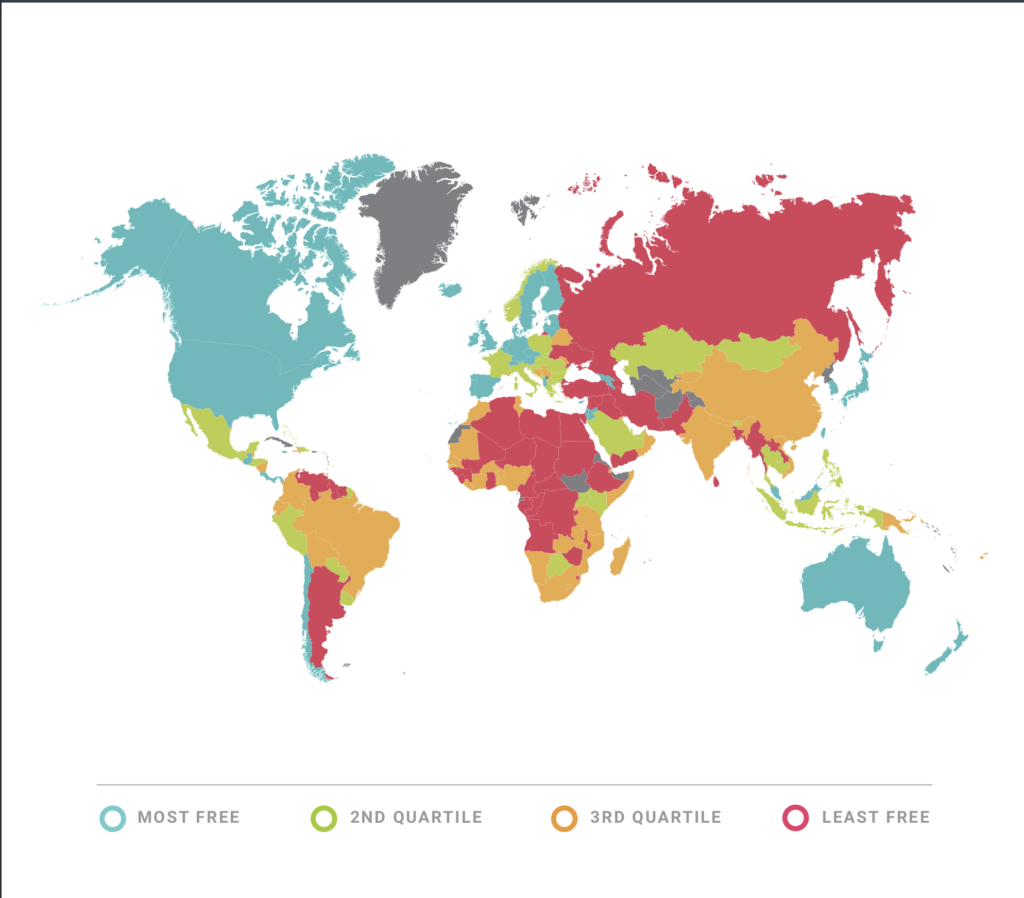
Executive Summary: The index published in Economic Freedom of the World (EFW) measures economic
freedom in up to 165 jurisdictions as far back as 1970. Economic freedoms are a sub
set of human freedoms and concern economic activity such as working, transacting,
contracting, and owning and using productive property.
Individuals are more economically free when they are allowed to make more of
their own economic choices, with others imposing fewer and less severe constraints
on those choices. They must, however, respect the rights of others.
The index measures economic freedom using 45 components and subcomponents
grouped into five areas: [1] Size of Government, [2] Legal System and Property Rights,
[3] Sound Money, [4] Freedom to Trade Internationally, and [5] Regulation. Each
component and subcomponent is placed on a scale from zero to 10, reflecting the
distribution of the underlying data.
In 2023—the latest year for which data are available—the 10 highest scoring
nations were Hong Kong, Singapore, New Zealand, Switzerland, the United States,
Ireland, Australia and Taiwan (tied for 7th), Denmark, and the Netherlands.
The rankings of other major world economies include Canada (11th), the United
Kingdom (13th), Germany (15th), Japan (17th), Korea (38th), France (44th), Italy
(46th), Indonesia (65th), Mexico (70th), India (86th), Brazil (87th), China (108th), and
Russia (148th).
The 10 lowest-ranked countries were Chad, Libya, Syria, Argentina, Myanmar,
Iran, Algeria, Sudan, Zimbabwe, and Venezuela.
Overall, the index shows that economic freedom has increased since 2000, but fell
precipitously following the coronavirus pandemic, erasing nearly a decade of progress.
Standards of living in the most economically free societies are significantly greater
than in the least free:
Those in the freest 25% of countries earn, on average, about 6.2 times as much
as those in the least free.
Though the share of income earned by the poorest 10% of the population is
unrelated to economic freedom, the level of income earned by the poorest 10%
of the population is much higher in countries with greater economic freedom.
The bottom 10% threshold is 7.8 times higher in the freest quartile than it is in
the least free.
The rate of poverty in the least-free quartile is about 25 times greater than it is
in the freest.
People in the least-free quartile work about 20% more than those in the freest.
People in the freest quartile live about 17 years longer than those in the least-free
quartile.
In the least free countries, infants die at nearly 10 times the rate as they do in the
freest countries.
Economic freedom is positively correlated with personal freedom, with life satis
faction, with non-corrupt government, and with a cleaner environment.
This year’s report includes four chapters.
In chapter 1, Robert Lawson, Ryan Murphy, and Matthew D. Mitchell provide an
overview of the report and its findings. They explain the concept of economic freedom
and how it is measured. They also explore recent trends in the data. The complete
dataset can be downloaded at https://www.freetheworld.com/ or by scanning the fol
lowing QR code:
In chapter 2, Robert Lawson and Matthew Mitchell estimate the effect of President
Trump’s tariffs on US economic freedom in 2025. They estimate that Trump’s tariffs
drop the US from 56th to 76th place in the world in terms of freedom to trade and
nearly knock the US out of the top 10 in terms of total economic freedom.
In Chapter 3, Walker Wright of the American Enterprise Institute examines the
relationship between economic freedom and peace. The empirical evidence suggests
that economic freedom can mitigate military conflict and cool tensions that arise from
ethnic, political, or religious disagreements. Wright argues that markets cultivate a
culture of peace through a process that is inherently non-violent.
In chapter 4, Dr. Horst Feldmann of the University of Bath (UK) examines the rela
tionship between economic freedom and the quality of education. Using PISA scores
from 47 countries and the World Bank’s harmonized test scores from 132 countries,
he finds that higher levels of economic freedom are associated with higher quality
education. The magnitude of the effect is large and grows larger once one accounts for
the fact that economic freedom raises GDP per capita, further increasing the returns
to education.